What is meant by Transient Current?
Transient current refers to a temporary flow of electric current that occurs in a circuit during certain events or conditions. These events can include switching operations, power surges, or sudden changes in voltage or current levels. Transient currents are typically characterised by their short duration and high magnitude, which can pose challenges to electrical systems and devices.
Transient currents can occur when a circuit is turned on or off, leading to an initial surge of current known as inrush current. This phenomenon often happens in power supplies, motors, or other devices with capacitors, where the sudden change in voltage causes a temporary spike in current. Another example of transient current is a power surge caused by lightning strikes or faults in the electrical grid, resulting in a sudden increase in current flow.
These transient currents can potentially damage electronic components, disrupt the normal operation of devices, or cause electromagnetic interference. To mitigate these effects, protective measures such as surge protectors, fuses, or transient voltage suppressors are employed to limit the impact of transient currents and ensure the stability and longevity of electrical systems.
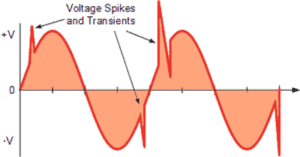 |
| Transient Current Diagram (Source : Alltecglobal.com) |
Also Read : Write Coulomb's Law in Vector Form.
Also Read : What do you mean by Persistent Currents in Superconductors?
No comments: